Introduction
Inflatable Packaging is widely used to protect sensitive products during transportation and storage. Ensuring the structural integrity of these packages is critical to prevent product damage, maintain consumer trust, and comply with industry standards. The packaging burst test is a key method for evaluating the strength and durability of inflatable packaging, while verifying seal performance. Professionals and quality control personnel rely on this testing to identify weaknesses in materials, detect potential failures, and guide improvements in packaging design.
What is a Packaging Burst Test?
A packaging burst test is designed to measure the maximum internal pressure that an inflatable package can withstand before failure. This test simulates stress conditions that may occur during sterilization, shipping, or storage. By using a package leak tester, manufacturers can apply controlled internal pressure until the package either deforms or bursts, providing quantitative data on material and seal performance.
Den ASTM F1140 standard provides detailed procedures for conducting both burst and creep tests, ensuring consistency and reliability in results. Following these guidelines allows manufacturers to compare different packaging materials, evaluate production quality, and ensure compliance with industry requirements.
Burst Test Procedure
In the burst test, the package is placed in a pressurization apparatus. The internal pressure is gradually increased while observing the package. Key steps include:
- Open Package Test: The package may be tested with or without its product. It must be positioned so that it can expand naturally, without constraint, during pressurization. The pressure is gradually increased until failure occurs, noting the pressure at which the package bursts and the type of failure (material rupture or seal failure).
- Closed Package Test: A sealed package is pressurized through an entry device, usually at the center. Care must be taken to avoid damaging the package during insertion. Pressure is applied gradually until failure, and the exact location and type of failure are recorded.
Creep Test Procedure
Creep testing evaluates how a package withstands a sustained internal pressure over a specific period:
- Creep Test (B1): The package is pressurized to a specified percentage of its expected burst pressure (commonly 80%) and held for a predetermined time, typically 15–30 seconds. Observers check for deformation or seal yielding.
- Creep to Failure (B2): The package is pressurized to a higher percentage (usually 90%) and maintained until failure occurs. The time to failure and pressure at failure are documented. Both open and closed package configurations are tested using similar procedures to ensure consistency.
Significance and Applications
Burst and creep tests provide valuable insights into the performance and reliability of inflatable packaging:
- Manufacturing Quality Control: Quickly evaluates packages during production, identifying material or seal defects before distribution.
- Product Design: Guides selection of materials and seals for optimal performance under stress conditions.
- Lifecycle Assessment: Tests packages at different stages, from initial production to storage, to assess durability over time.
- Regulatory Compliance: Supports documentation and adherence to packaging standards, improving safety and consumer trust.
Benefits of Using a Package Leak Tester
Modern package leak testers, like the Cell Instruments LSST-01 Leak and Seal Strength Tester, streamline burst and creep testing. Benefits include:
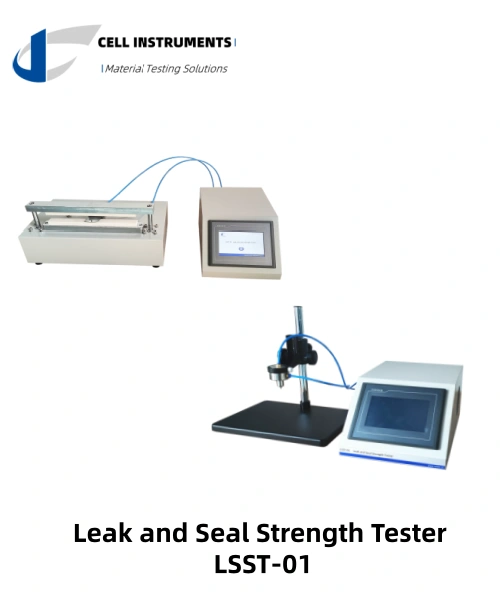
- Accurate Results: Provides precise measurement of internal pressure and detects early signs of package weakness.
- Efficiency: Automated pressurization reduces manual effort and increases testing throughput.
- Traceability: Captures detailed test data for reporting, quality assurance, and auditing.
Conclusion
Ensuring the integrity of inflatable packaging is vital for product protection and brand reputation. Conducting packaging burst tests and creep evaluations in accordance with ASTM F1140 enables manufacturers to identify weak points in materials and seals, optimize packaging design, and ensure safe transport. Using advanced package leak testers like the Cell Instruments LSST-01 helps maintain rigorous quality standards, protect products, and enhance consumer confidence.
With proper testing, companies can reduce packaging failures, improve operational efficiency, and maintain compliance with industry standards, making burst and creep testing an essential component of modern packaging quality control.
 DA
DA  EN
EN  AR
AR  BG
BG  CS
CS  DE
DE  EL
EL  ES
ES  ET
ET  FI
FI  FR
FR  HU
HU  ID
ID  IT
IT  JA
JA  KO
KO  LT
LT  LV
LV  NB
NB  NL
NL  PL
PL  PT
PT  RO
RO  RU
RU  SK
SK  SL
SL  SV
SV  TR
TR  UK
UK